# ⏲ Geschwindigkeit

![Bike-Geschwindigkeit.jpg](https://drivecouch.pikapod.net/uploads/images/gallery/2026-06/scaled-1680-/bike-geschwindigkeit.jpg)

## Geschwindigkeit: Fahrstabilität &amp; Highspeed

<div class="n6owBd awi2gc" data-complete="true" data-copy-service-computed-style="font-family: "Google Sans", Arial, sans-serif; font-size: 16px; font-weight: 400; margin: 12px 0px 16px; text-decoration: none; border-bottom: 0px rgb(10, 10, 10);" data-hveid="CAAIBhAA" data-processed="true" data-sfc-cb="" data-sfc-cp="" data-sfc-root="c" id="bkmrk-die-physik-des-motor" jsaction="" jscontroller="TDBkbc#Ml18Xb" jsuid="V4m5s_y">Die Physik des Motorradfahrens unterscheidet sich grundlegend vom Autofahren. Während ein Pkw durch seine vier Räder immer mechanisch stabil steht, ist ein Motorrad ein hochdynamisches System. Je nachdem, wie schnell du fährst, verändert sich das Fahrverhalten deines Bikes radikal. Das Zusammenspiel aus Kreiselkräften, Fahrwerksgeometrie und Aerodynamik erfordert bei hohem Tempo maximale Aufmerksamkeit und eine perfekte Fahrzeugkontrolle.</div><div class="Fsg96" data-complete="true" data-copy-service-computed-style="font-family: "Google Sans", Arial, sans-serif; font-size: 14px; font-weight: 400; margin: 0px; text-decoration: none; border-bottom: 0px rgb(10, 10, 10);" data-processed="true" data-sfc-cb="" data-sfc-cp="" data-sfc-inited="2" data-sfc-root="c" id="bkmrk--1" jsaction="rcuQ6b:&V4m5s_13|npT2md" jscontroller="KHhJQ#U8DOt" jsuid="V4m5s_13"></div>---

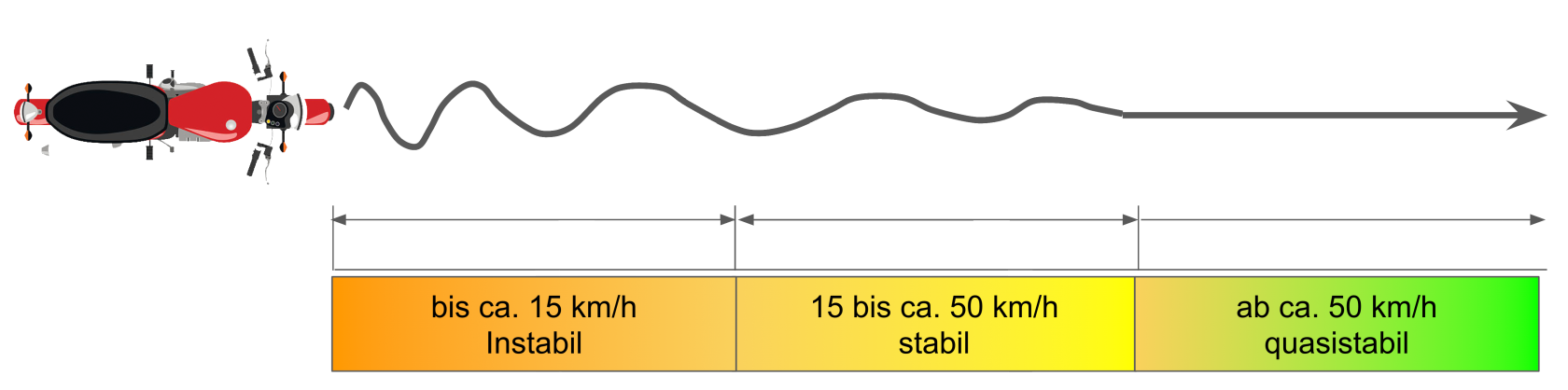
<div class="Fsg96" data-complete="true" data-copy-service-computed-style="font-family: "Google Sans", Arial, sans-serif; font-size: 14px; font-weight: 400; margin: 0px; text-decoration: none; border-bottom: 0px rgb(10, 10, 10);" data-processed="true" data-sfc-cb="" data-sfc-cp="" data-sfc-inited="2" data-sfc-root="c" id="bkmrk--3" jsaction="rcuQ6b:&V4m5s_15|npT2md" jscontroller="KHhJQ#U8DOt" jsuid="V4m5s_15"></div>#### Die 3 Stabilitäts-Zonen des Motorrads

<div class="Fsg96" data-complete="true" data-copy-service-computed-style="font-family: "Google Sans", Arial, sans-serif; font-size: 14px; font-weight: 400; margin: 0px; text-decoration: none; border-bottom: 0px rgb(10, 10, 10);" data-processed="true" data-sfc-cb="" data-sfc-cp="" data-sfc-inited="2" data-sfc-root="c" id="bkmrk--4" jsaction="rcuQ6b:&V4m5s_1b|npT2md" jscontroller="KHhJQ#U8DOt" jsuid="V4m5s_1b"></div>##### 1. Der instabile Bereich (Unter 20 km/h)

- <span class="T286Pc" data-complete="true" data-copy-service-computed-style="font-family: "Google Sans", Arial, sans-serif; font-size: 16px; font-weight: 400; margin: 0px; text-decoration: none; border-bottom: 0px rgb(10, 10, 10);" data-sfc-cb="" data-sfc-cp="" data-sfc-root="c">**Die Physik:**   
    Bei sehr niedrigen Geschwindigkeiten (z. B. im Stop-and-go-Verkehr, beim Wenden oder langsamen Abbiegen) rotieren die Reifen zu langsam. Dadurch entsteht kaum ein spürbarer Kreiseleffekt (Gyroskopischer Effekt), der die Maschine aufrecht halten könnte. Auch der stabilisierende Nachlauf der Lenkgeometrie greift hier noch nicht.</span>

<p class="callout info"><span class="T286Pc" data-complete="true" data-copy-service-computed-style="font-family: "Google Sans", Arial, sans-serif; font-size: 16px; font-weight: 400; margin: 0px; text-decoration: none; border-bottom: 0px rgb(10, 10, 10);" data-sfc-cb="" data-sfc-cp="" data-sfc-root="c">**Deine Aufgabe:**   
Das Motorrad ist in dieser Zone extrem kippanfällig. Genau wie beim langsamen Fahrradfahren musst du die Maschine durch permanente, feine Lenkbewegungen und aktive Gewichtsverlagerung im Gleichgewicht halten.</span></p>

<div class="Fsg96" data-complete="true" data-copy-service-computed-style="font-family: "Google Sans", Arial, sans-serif; font-size: 14px; font-weight: 400; margin: 0px; text-decoration: none; border-bottom: 0px rgb(10, 10, 10);" data-processed="true" data-sfc-cb="" data-sfc-cp="" data-sfc-inited="2" data-sfc-root="c" id="bkmrk--5" jsaction="rcuQ6b:&V4m5s_1w|npT2md" jscontroller="KHhJQ#U8DOt" jsuid="V4m5s_1w"></div>##### 2. Der selbststabile Bereich (Ca. 30 bis 70 km/h)

- <span class="T286Pc" data-complete="true" data-copy-service-computed-style="font-family: "Google Sans", Arial, sans-serif; font-size: 16px; font-weight: 400; margin: 0px; text-decoration: none; border-bottom: 0px rgb(10, 10, 10);" data-sfc-cb="" data-sfc-cp="" data-sfc-root="c">**Die Physik:**   
    Ab einer mittleren Geschwindigkeit verändert sich das Bike komplett. Durch das höhere Tempo drehen sich die Räder so schnell, dass die Kreiselkräfte massiv ansteigen und das Motorrad wie von Geisterhand in der Senkrechten stabilisieren. Gleichzeitig greift der **Nachlauf** deines Fahrwerks: Er sorgt dafür, dass sich das Vorderrad nach einer Störung (z. B. einer Bodenwelle) von ganz alleine wieder schurgerade ausrichtet.</span>

<p class="callout info"><span class="T286Pc" data-complete="true" data-copy-service-computed-style="font-family: "Google Sans", Arial, sans-serif; font-size: 16px; font-weight: 400; margin: 0px; text-decoration: none; border-bottom: 0px rgb(10, 10, 10);" data-sfc-cb="" data-sfc-cp="" data-sfc-root="c">**Deine Aufgabe:** Das Motorrad fährt hier extrem sicher und stabil geradeaus. Kleine Störungen gleicht die Physik selbstständig aus, du musst kaum aktiv eingreifen.</span></p>

<div class="Fsg96" data-complete="true" data-copy-service-computed-style="font-family: "Google Sans", Arial, sans-serif; font-size: 14px; font-weight: 400; margin: 0px; text-decoration: none; border-bottom: 0px rgb(10, 10, 10);" data-processed="true" data-sfc-cb="" data-sfc-cp="" data-sfc-inited="2" data-sfc-root="c" id="bkmrk--6" jsaction="rcuQ6b:&V4m5s_2i|npT2md" jscontroller="KHhJQ#U8DOt" jsuid="V4m5s_2i"></div>##### 3. Der quasistabile Bereich (Ab ca. 80 km/h)

- <span class="T286Pc" data-complete="true" data-copy-service-computed-style="font-family: "Google Sans", Arial, sans-serif; font-size: 16px; font-weight: 400; margin: 0px; text-decoration: none; border-bottom: 0px rgb(10, 10, 10);" data-sfc-cb="" data-sfc-cp="" data-sfc-root="c">**Die Physik:**   
    Bei hohem Tempo (Landstraße und Autobahn) sind die Kreiselkräfte der Räder so gigantisch, dass das Motorrad starr wie ein Brett in Fahrtrichtung gepresst wird. Das bringt maximalen Geradeauslauf, hat aber einen Haken: Das Bike wird widerständig gegen Lenkimpulse. Jede Richtungsänderung erfordert deutlich mehr bewussten Krafteinsatz (Lenkimpuls) am Lenker. Zudem schlägt jetzt die Aerodynamik voll zu: Seitenwind oder die Luftverwirbelungen von vorausfahrenden Lkw zerren massiv an Maschine und Fahrer.</span>

<p class="callout info"><span class="T286Pc" data-complete="true" data-copy-service-computed-style="font-family: "Google Sans", Arial, sans-serif; font-size: 16px; font-weight: 400; margin: 0px; text-decoration: none; border-bottom: 0px rgb(10, 10, 10);" data-sfc-cb="" data-sfc-cp="" data-sfc-root="c">**Deine Aufgabe:** Nimm eine entspannte, aber absolut aufmerksame Körperhaltung ein. Halte den Lenker locker, aber bestimmt, um Windböen abzufedern und Richtungswechsel gezielt einzuleiten.</span></p>

<div class="Fsg96" data-complete="true" data-copy-service-computed-style="font-family: "Google Sans", Arial, sans-serif; font-size: 14px; font-weight: 400; margin: 0px; text-decoration: none; border-bottom: 0px rgb(10, 10, 10);" data-processed="true" data-sfc-cb="" data-sfc-cp="" data-sfc-inited="2" data-sfc-root="c" id="bkmrk--7" jsaction="rcuQ6b:&V4m5s_33|npT2md" jscontroller="KHhJQ#U8DOt" jsuid="V4m5s_33"></div>[![Geschwingkeitsberereiche.png](https://drivecouch.pikapod.net/uploads/images/gallery/2026-06/scaled-1680-/geschwingkeitsberereiche.png)](https://drivecouch.pikapod.net/uploads/images/gallery/2026-06/geschwingkeitsberereiche.png)

---

<div class="Fsg96" data-complete="true" data-copy-service-computed-style="font-family: "Google Sans", Arial, sans-serif; font-size: 14px; font-weight: 400; margin: 0px; text-decoration: none; border-bottom: 0px rgb(10, 10, 10);" data-processed="true" data-sfc-cb="" data-sfc-cp="" data-sfc-inited="2" data-sfc-root="c" id="bkmrk--10" jsaction="rcuQ6b:&V4m5s_35|npT2md" jscontroller="KHhJQ#U8DOt" jsuid="V4m5s_35"></div>#### Fahrpraxis bei hoher Geschwindigkeit (Autobahn &amp; Co.)

<div class="n6owBd awi2gc" data-complete="true" data-copy-service-computed-style="font-family: "Google Sans", Arial, sans-serif; font-size: 16px; font-weight: 400; margin: 12px 0px 16px; text-decoration: none; border-bottom: 0px rgb(10, 10, 10);" data-hveid="CAAIERAA" data-processed="true" data-sfc-cb="" data-sfc-cp="" data-sfc-root="c" id="bkmrk-wenn-du-den-selbstst" jsaction="" jscontroller="TDBkbc#Ml18Xb" jsuid="V4m5s_3b">Wenn du den selbststabilen Bereich verlässt und auf die Autobahn fährst, steigen die mentalen und körperlichen Herausforderungen im Cockpit massiv an. Da jede kleinste Bewegung am Lenker bei hohem Tempo größere Auswirkungen hat, gelten hier strenge Spielregeln:</div><div class="Fsg96" data-complete="true" data-copy-service-computed-style="font-family: "Google Sans", Arial, sans-serif; font-size: 14px; font-weight: 400; margin: 0px; text-decoration: none; border-bottom: 0px rgb(10, 10, 10);" data-processed="true" data-sfc-cb="" data-sfc-cp="" data-sfc-inited="2" data-sfc-root="c" id="bkmrk--11" jsaction="rcuQ6b:&V4m5s_3g|npT2md" jscontroller="KHhJQ#U8DOt" jsuid="V4m5s_3g"></div>##### Das richtige Einfahren auf die Autobahn

1. <span class="T286Pc" data-complete="true" data-copy-service-computed-style="font-family: "Google Sans", Arial, sans-serif; font-size: 16px; font-weight: 400; margin: 0px; text-decoration: none; border-bottom: 0px rgb(10, 10, 10);" data-sfc-cb="" data-sfc-cp="" data-sfc-root="c">**Beschleunigungsstreifen voll nutzen:**   
    Beschleunige auf dem Auffahrstreifen zügig und dynamisch durch, um dein Tempo an den fließenden Verkehr auf der Hauptfahrbahn anzupassen.</span>
2. <span class="T286Pc" data-complete="true" data-copy-service-computed-style="font-family: "Google Sans", Arial, sans-serif; font-size: 16px; font-weight: 400; margin: 0px; text-decoration: none; border-bottom: 0px rgb(10, 10, 10);" data-sfc-cb="" data-sfc-cp="" data-sfc-root="c">**Absichern &amp; Blinken:**   
    Setze frühzeitig den linken Blinker und mache den lebenswichtigen Schulterblick nach hinten links, um herannahende Fahrzeuge zu checken.</span>
3. <span class="T286Pc" data-complete="true" data-copy-service-computed-style="font-family: "Google Sans", Arial, sans-serif; font-size: 16px; font-weight: 400; margin: 0px; text-decoration: none; border-bottom: 0px rgb(10, 10, 10);" data-sfc-cb="" data-sfc-cp="" data-sfc-root="c">**Lücke treffen:**   
    Warte nicht zögerlich bis zum Ende des Streifens. Ziehe selbstbewusst, flüssig und mit passendem Tempo in eine ausreichend große Lücke ein.</span>

<div class="Fsg96" data-complete="true" data-copy-service-computed-style="font-family: "Google Sans", Arial, sans-serif; font-size: 14px; font-weight: 400; margin: 0px; text-decoration: none; border-bottom: 0px rgb(10, 10, 10);" data-processed="true" data-sfc-cb="" data-sfc-cp="" data-sfc-inited="2" data-sfc-root="c" id="bkmrk--12" jsaction="rcuQ6b:&V4m5s_48|npT2md" jscontroller="KHhJQ#U8DOt" jsuid="V4m5s_48"></div>##### Die Herausforderungen im Highspeed-Bereich

- <span class="T286Pc" data-complete="true" data-copy-service-computed-style="font-family: "Google Sans", Arial, sans-serif; font-size: 16px; font-weight: 400; margin: 0px; text-decoration: none; border-bottom: 0px rgb(10, 10, 10);" data-sfc-cb="" data-sfc-cp="" data-sfc-root="c">**Der brutale Windwiderstand:**   
    Bei hohen Geschwindigkeiten wächst der Luftwiderstand quadratisch. Der Wind prallt mit massiver Kraft gegen deinen Helm und Oberkörper, was extrem ermüdend wirkt. Eine stabile, aerodynamische Körperhaltung (ggf. leicht nach vorne ducken) ist Pflicht, um dich nicht verkrampft am Lenker festkrallen zu müssen.</span>
- <span class="T286Pc" data-complete="true" data-copy-service-computed-style="font-family: "Google Sans", Arial, sans-serif; font-size: 16px; font-weight: 400; margin: 0px; text-decoration: none; border-bottom: 0px rgb(10, 10, 10);" data-sfc-cb="" data-sfc-cp="" data-sfc-root="c">**Kürzere Reaktionszeit &amp; Bremsweg:**   
    Auf Schnellstraßen bewegen sich alle Fahrzeuge mit hohem Tempo. Plötzliche Spurwechsel von Autofahrern oder abruptes Bremsen des Vordermanns erfordern blitzschnelle Reaktionen. Fahre extrem vorausschauend, halte die Augen weit vorne und verdoppele deinen Sicherheitsabstand.</span>
- <span class="T286Pc" data-complete="true" data-copy-service-computed-style="font-family: "Google Sans", Arial, sans-serif; font-size: 16px; font-weight: 400; margin: 0px; text-decoration: none; border-bottom: 0px rgb(10, 10, 10);" data-sfc-cb="" data-sfc-cp="" data-sfc-root="c">**Kurvenfahrten im Highspeed:**   
    Bei hohem Tempo neigt sich das Motorrad in Kurven deutlich stärker gegen die Fliehkraft. Lenke sanft und progressiv ein. Richte deinen Blick starr in Richtung des Kurvenausgangs – das Motorrad fährt immer genau dorthin, wo du hinschaust!</span>
- <span class="T286Pc" data-complete="true" data-copy-service-computed-style="font-family: "Google Sans", Arial, sans-serif; font-size: 16px; font-weight: 400; margin: 0px; text-decoration: none; border-bottom: 0px rgb(10, 10, 10);" data-sfc-cb="" data-sfc-cp="" data-sfc-root="c">**Der Spurwechsel bei Highspeed:**   
    Ein Fahrstreifenwechsel auf der Autobahn erfordert bei hohem Tempo absolute Präzision. Da die Kreiselkräfte das Motorrad extrem spurstabil halten, musst du den Richtungswechsel bewusst über einen präzisen Lenkimpuls einleiten. Vermeide hektische oder ruckartige Bewegungen am Lenker – diese können das Fahrwerk bei über 100 km/h sofort unruhig machen und zum Pendeln führen. Die Devise lautet: Frühzeitig blinken, die Blickkette (Spiegel, Spiegel, Schulterblick) sauber durchziehen und die Spur in einer sanften, fließenden Linie wechseln.</span>
- <span class="T286Pc" data-complete="true" data-copy-service-computed-style="font-family: "Google Sans", Arial, sans-serif; font-size: 16px; font-weight: 400; margin: 0px; text-decoration: none; border-bottom: 0px rgb(10, 10, 10);" data-sfc-cb="" data-sfc-cp="" data-sfc-root="c">**Achtsames Überholen:**   
    Fahre absolut defensiv. Willst du ein Fahrzeug überholen, setze den Blinker sehr frühzeitig, sichere den toten Winkel per Schulterblick ab und wechsle die Spur mit einer ruhigen, stabilen Lenkbewegung. Halte beim Passieren von Lkw großen Seitenabstand, um nicht von deren Windschleppen erfasst zu werden.</span>

<div class="Fsg96" data-complete="true" data-copy-service-computed-style="font-family: "Google Sans", Arial, sans-serif; font-size: 14px; font-weight: 400; margin: 0px; text-decoration: none; border-bottom: 0px rgb(10, 10, 10);" data-processed="true" data-sfc-cb="" data-sfc-cp="" data-sfc-inited="2" data-sfc-root="c" id="bkmrk--13" jsaction="rcuQ6b:&V4m5s_4v|npT2md" jscontroller="KHhJQ#U8DOt" jsuid="V4m5s_4v"></div>---

<div class="Fsg96" data-complete="true" data-copy-service-computed-style="font-family: "Google Sans", Arial, sans-serif; font-size: 14px; font-weight: 400; margin: 0px; text-decoration: none; border-bottom: 0px rgb(10, 10, 10);" data-processed="true" data-sfc-cb="" data-sfc-cp="" data-sfc-inited="2" data-sfc-root="c" id="bkmrk--15" jsaction="rcuQ6b:&V4m5s_4x|npT2md" jscontroller="KHhJQ#U8DOt" jsuid="V4m5s_4x"></div>#### Kritische Fahrzustände: Wenn das Bike anfängt zu schwingen

<div class="n6owBd awi2gc" data-complete="true" data-copy-service-computed-style="font-family: "Google Sans", Arial, sans-serif; font-size: 16px; font-weight: 400; margin: 12px 0px 16px; text-decoration: none; border-bottom: 0px rgb(10, 10, 10);" data-hveid="CAAIGBAA" data-processed="true" data-sfc-cb="" data-sfc-cp="" data-sfc-root="c" id="bkmrk-unter-bestimmten-bed" jsaction="" jscontroller="TDBkbc#Ml18Xb" jsuid="V4m5s_53">Unter bestimmten Bedingungen (z. B. durch unebene Fahrbahnen, falsche Beladung oder Windböen) kann das physikalische Gleichgewicht gestört werden. Es entstehen gefährliche Schwingungen im Fahrwerk:</div><div class="Fsg96" data-complete="true" data-copy-service-computed-style="font-family: "Google Sans", Arial, sans-serif; font-size: 14px; font-weight: 400; margin: 0px; text-decoration: none; border-bottom: 0px rgb(10, 10, 10);" data-processed="true" data-sfc-cb="" data-sfc-cp="" data-sfc-inited="2" data-sfc-root="c" id="bkmrk--16" jsaction="rcuQ6b:&V4m5s_58|npT2md" jscontroller="KHhJQ#U8DOt" jsuid="V4m5s_58"></div><div aria-level="3" class="AdPoic" data-animation-nesting="" data-complete="true" data-copy-service-computed-style="font-family: "Google Sans", Arial, sans-serif; font-size: 16px; font-weight: 600; margin: 24px 0px 12px; text-decoration: none; border-bottom: 0px rgb(10, 10, 10);" data-processed="true" data-sae="" data-sfc-cb="" data-sfc-cp="" data-sfc-root="c" id="bkmrk--17" jsaction="" jscontroller="SF2W9b#clbHl" jsuid="V4m5s_59" role="heading"></div>##### Das Lenkerflattern (Low-Speed Shimmy)

- <span class="T286Pc" data-complete="true" data-copy-service-computed-style="font-family: "Google Sans", Arial, sans-serif; font-size: 16px; font-weight: 400; margin: 0px; text-decoration: none; border-bottom: 0px rgb(10, 10, 10);" data-sfc-cb="" data-sfc-cp="" data-sfc-root="c">**Wann:**   
    Hauptsächlich im mittleren Bereich zwischen **40 und 80 km/h**.</span>
- <span class="T286Pc" data-complete="true" data-copy-service-computed-style="font-family: "Google Sans", Arial, sans-serif; font-size: 16px; font-weight: 400; margin: 0px; text-decoration: none; border-bottom: 0px rgb(10, 10, 10);" data-sfc-cb="" data-sfc-cp="" data-sfc-root="c">**Was passiert:**   
    Der Lenker vibriert unkontrolliert und hochfrequent von links nach rechts.</span>
- <span class="T286Pc" data-complete="true" data-copy-service-computed-style="font-family: "Google Sans", Arial, sans-serif; font-size: 16px; font-weight: 400; margin: 0px; text-decoration: none; border-bottom: 0px rgb(10, 10, 10);" data-sfc-cb="" data-sfc-cp="" data-sfc-root="c">**Ursachen:**   
    Ungleichmäßig abgenutzte Reifen, falscher Reifendruck, Spiel im Lenkkopflager oder eine Heck-Überladung (z. B. durch schweres Gepäck/Topcase), die das Vorderrad entlastet.</span>

<p class="callout success"><span class="T286Pc" data-complete="true" data-copy-service-computed-style="font-family: "Google Sans", Arial, sans-serif; font-size: 16px; font-weight: 400; margin: 0px; text-decoration: none; border-bottom: 0px rgb(10, 10, 10);" data-sfc-cb="" data-sfc-cp="" data-sfc-root="c">**Deine Reaktion:** Bloß nicht panisch am Lenker reißen! Halte ihn fest, aber blockiere die Schwingung nicht mit roher Gewalt. Reduziere sofort das Gas und verlagere dein Körpergewicht leicht nach vorne auf den Tank, um Druck auf das Vorderrad zu bringen. Das Flattern verschwindet, sobald das Tempo sinkt.</span></p>

<div class="Fsg96" data-complete="true" data-copy-service-computed-style="font-family: "Google Sans", Arial, sans-serif; font-size: 14px; font-weight: 400; margin: 0px; text-decoration: none; border-bottom: 0px rgb(10, 10, 10);" data-processed="true" data-sfc-cb="" data-sfc-cp="" data-sfc-inited="2" data-sfc-root="c" id="bkmrk--18" jsaction="rcuQ6b:&V4m5s_5w|npT2md" jscontroller="KHhJQ#U8DOt" jsuid="V4m5s_5w"></div>##### <iframe allowfullscreen="allowfullscreen" height="478" src="https://www.youtube.com/embed/oUl_V3q8QFc" style="width: 852px; height: 478px;" width="852"></iframe>


##### Das Hochgeschwindigkeits-Pendeln (High-Speed Weave &amp; Wobble)

- <span class="T286Pc" data-complete="true" data-copy-service-computed-style="font-family: "Google Sans", Arial, sans-serif; font-size: 16px; font-weight: 400; margin: 0px; text-decoration: none; border-bottom: 0px rgb(10, 10, 10);" data-sfc-cb="" data-sfc-cp="" data-sfc-root="c">**Wann:**   
    Tritt bei schnellen Fahrten ab **ca. 120 km/h** bis zur Höchstgeschwindigkeit auf.</span>
- <span class="T286Pc" data-complete="true" data-copy-service-computed-style="font-family: "Google Sans", Arial, sans-serif; font-size: 16px; font-weight: 400; margin: 0px; text-decoration: none; border-bottom: 0px rgb(10, 10, 10);" data-sfc-cb="" data-sfc-cp="" data-sfc-root="c">**Weave (Das Pendeln):**   
    Das gesamte Motorrad gerät in eine großflächige, weiche Pendelbewegung um die Längsachse (oft ausgelöst durch lose Textilkleidung, Packtaschen oder ein falsch eingestelltes Federbein).</span>
- <span class="T286Pc" data-complete="true" data-copy-service-computed-style="font-family: "Google Sans", Arial, sans-serif; font-size: 16px; font-weight: 400; margin: 0px; text-decoration: none; border-bottom: 0px rgb(10, 10, 10);" data-sfc-cb="" data-sfc-cp="" data-sfc-root="c">**Wobble (Das Lenkerschlagen):**   
    Ein schlagartiges, extrem heftiges Hin- und Herreißen des Lenkers von Anschlag zu Anschlag, meist ausgelöst durch ein entlastetes Vorderrad beim harten Beschleunigen über eine Bodenwelle.</span>

<p class="callout success"><span class="T286Pc" data-complete="true" data-copy-service-computed-style="font-family: "Google Sans", Arial, sans-serif; font-size: 16px; font-weight: 400; margin: 0px; text-decoration: none; border-bottom: 0px rgb(10, 10, 10);" data-sfc-cb="" data-sfc-cp="" data-sfc-root="c">**Deine Reaktion:** Das ist ein akuter Notfall! Versuche niemals, das Schlingern durch Gasgeben „glattzuziehen“. **Lege deinen Oberkörper flach auf den Tank (um den Windwiderstand zu minimieren), stabilisiere den Lenker und leite sofort eine kontrollierte Bremsung ein**, um das Tempo schlagartig zu senken und das Fahrwerk zu beruhigen.</span></p>

<div class="Fsg96" data-complete="true" data-copy-service-computed-style="font-family: "Google Sans", Arial, sans-serif; font-size: 14px; font-weight: 400; margin: 0px; text-decoration: none; border-bottom: 0px rgb(10, 10, 10);" data-processed="true" data-sfc-cb="" data-sfc-cp="" data-sfc-inited="2" data-sfc-root="c" id="bkmrk--20" jsaction="rcuQ6b:&V4m5s_6l|npT2md" jscontroller="KHhJQ#U8DOt" jsuid="V4m5s_6l"></div>---

<div class="Fsg96 align-center" data-complete="true" data-copy-service-computed-style="font-family: "Google Sans", Arial, sans-serif; font-size: 14px; font-weight: 400; margin: 0px; text-decoration: none; border-bottom: 0px rgb(10, 10, 10);" data-processed="true" data-sfc-cb="" data-sfc-cp="" data-sfc-inited="2" data-sfc-root="c" id="bkmrk--22" jsaction="rcuQ6b:&V4m5s_6n|npT2md" jscontroller="KHhJQ#U8DOt" jsuid="V4m5s_6n"><audio controls="controls" src="https://media.thommessen.group/wp-content/uploads/Geschwindigkeit-Bike.mp3"></audio></div><div class="Fsg96" data-complete="true" data-copy-service-computed-style="font-family: "Google Sans", Arial, sans-serif; font-size: 14px; font-weight: 400; margin: 0px; text-decoration: none; border-bottom: 0px rgb(10, 10, 10);" data-processed="true" data-sfc-cb="" data-sfc-cp="" data-sfc-inited="2" data-sfc-root="c" id="bkmrk--23" jsaction="rcuQ6b:&V4m5s_6n|npT2md" jscontroller="KHhJQ#U8DOt" jsuid="V4m5s_6n"></div>> <div class="n6owBd awi2gc" data-complete="true" data-copy-service-computed-style="font-family: "Google Sans", Arial, sans-serif; font-size: 16px; font-weight: 400; margin: 0px; text-decoration: none; border-bottom: 0px rgb(10, 10, 10);" data-hveid="CAAIHhAB" data-sfc-cb="" data-sfc-cp="" data-sfc-root="c" jsaction="" jscontroller="TDBkbc#Ml18Xb" jsuid="V4m5s_6p">**💡 Fazit:**  
> Geschwindigkeit steuert die Stabilität deines Bikes: Unter 20 km/h musst du aktiv balancieren, zwischen 30 und 70 km/h stabilisiert sich die Maschine komplett von selbst, und ab 80 km/h wird das Motorrad durch extreme Kreiselkräfte lenkträge. Beim Fahren auf der Autobahn gilt: Zügig beschleunigen, defensiv überholen und permanent vorausschauend den Verkehr scannen.</div>

<div class="Fsg96" data-complete="true" data-copy-service-computed-style="font-family: "Google Sans", Arial, sans-serif; font-size: 14px; font-weight: 400; margin: 0px; text-decoration: none; border-bottom: 0px rgb(10, 10, 10);" data-processed="true" data-sfc-cb="" data-sfc-cp="" data-sfc-inited="2" data-sfc-root="c" id="bkmrk--24" jsaction="rcuQ6b:&V4m5s_6w|npT2md" jscontroller="KHhJQ#U8DOt" jsuid="V4m5s_6w"></div>---